A card for every class
Each class has its own day, age band, capacity and prices, and says on the card whether it has places.
Several classes a week, terms that start mid-way, and one page that says which ones have places.

Ballet on Tuesday, tap on Thursday, a grade class on Saturday, and every question about all three in one thread.
A dancer joins in week six, and somebody works out six classes at the term rate, by hand.
The beginners' class is full, the enquiries keep arriving, and the list of who asked first is somebody's memory.
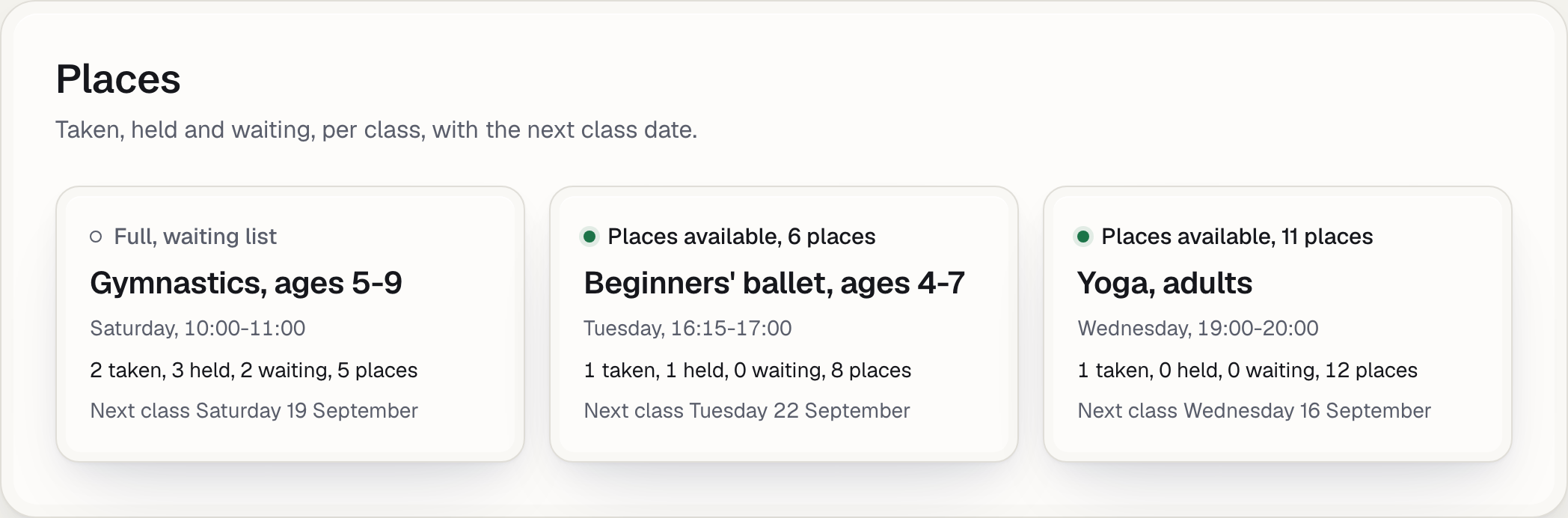
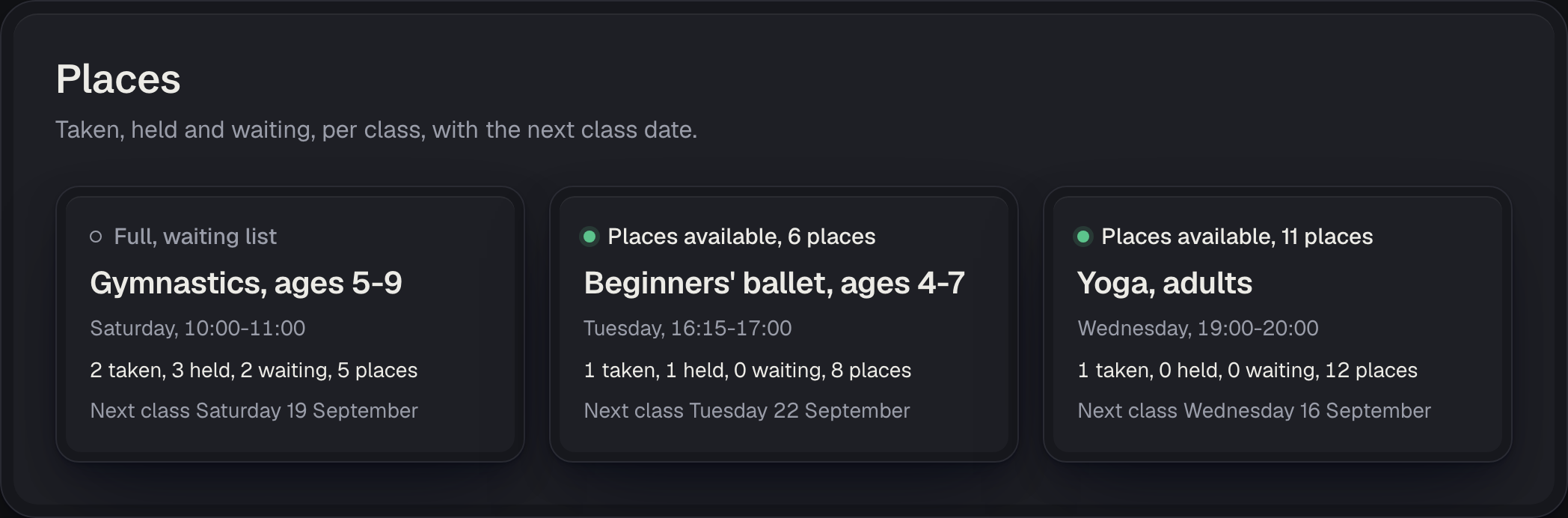
One tile per class: taken, held, waiting, and the next date. The same facts your page states to a parent.
Each class has its own day, age band, capacity and prices, and says on the card whether it has places.
Once the first date has passed, the page quotes the classes still to come, rounded to whole pounds.
Pick a date and the names are there. Came and Missed each take one class off what was bought.
A full class takes names in order, and the freed place is offered to the first family and held for 48 hours.
1.5 per cent of the class price on each card booking. Nothing else.
of the class price, on each card booking
a month, whatever you sell
in a month with no card bookings
There is no monthly fee. Stripe's own card fee is separate and is Stripe's to set.
Card payments are made on your own Stripe account. Callover never holds the money and cannot move it.
Yes. Each class is its own card with its own day, time, age band, capacity and products.
Children's and adults' classes sit on the same page, and each asks for what it needs.
A block is a number of classes bought at once. A term is a list of dates, so it can be priced part-way through.
A month is four classes, and it starts on the first class attended rather than the first of the month.
Yes, when you switch it on. The confirmation then offers both, and a payment taken at the door is logged in the dashboard.
It carries no Callover fee, because no card was taken through the page.
The demo runs a gymnastics class, a ballet term part-way through, and an adults' yoga class.